
20 years focus on Filter Press!
Excellent quality & 7x24 hours After-sales Service
Tel & WhatsApp+8613932818978
20 years focus on Filter Press!
Excellent quality & 7x24 hours After-sales Service
Crimping is plastic deformation of the ferrule wall, followed by cold flow into the gaps around the wire reinforcement. Force scales with ferrule circumference and wall thickness, which is why machine...
Tel & WhatsApp+8613932818978
Product Details
A 2-inch six-spiral assembly — EN 856 4SH — carries 250 bar working pressure at that size, and the hose alone measures 67.5 mm across before a ferrule goes on. Most workshop crimpers stop at 51 mm. The assembly goes out to a hose shop, comes back in two or three days, and the machine that needs it sits idle.
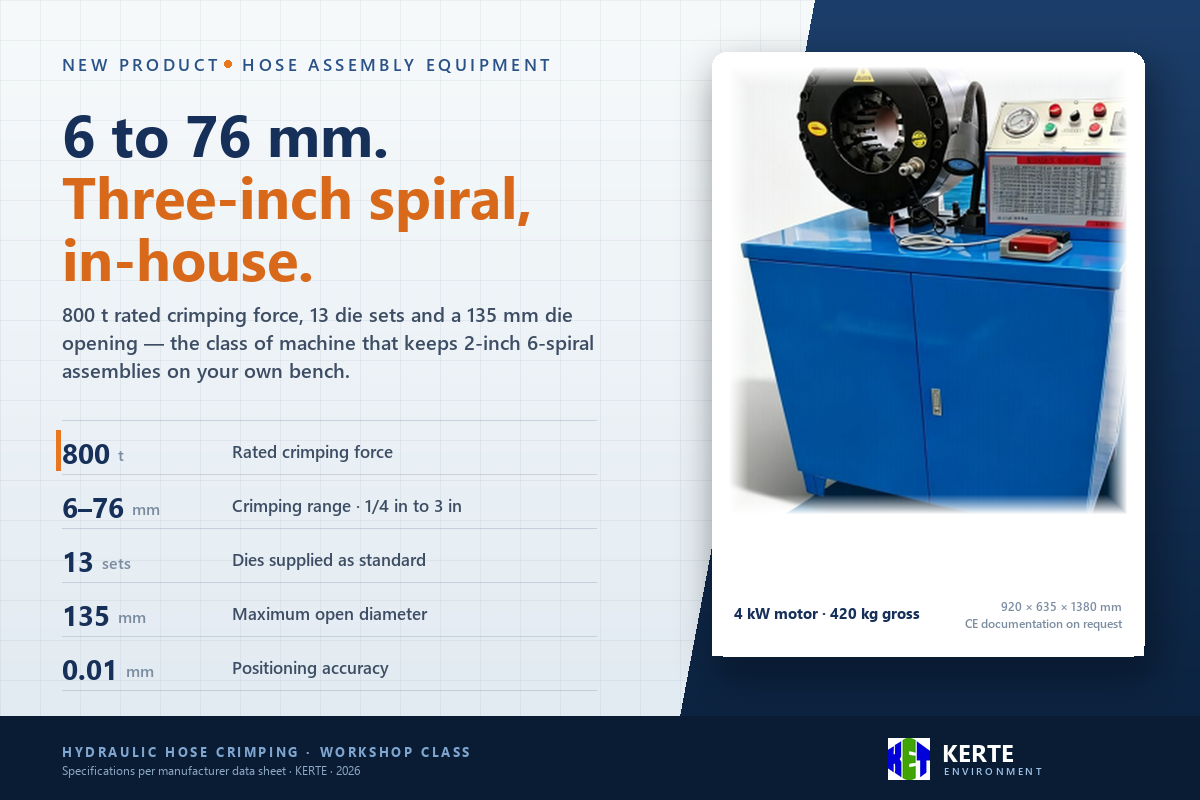
This is the gap our new crimping machine is built for: 6–76 mm crimping range, 13 die sets, 135 mm maximum open diameter, 800 t rated crimping force, 4 kW motor, 420 kg gross.
Four of those numbers decide whether the machine fits your bench: the 76 mm ceiling, the 800 t rating, the 13 die sets and the 0.01 mm figure. Each means less than it appears to on a data sheet, so they are worth taking in order. Full specifications and the ordering route are at the end.
The crimping range is quoted in millimetres, but hose is bought in dash sizes. The table below converts one to the other and adds the working pressure each construction carries, so you can see where the top of the range falls.
| Dash | Nominal ID | EN 853 2SN | EN 856 4SP | EN 856 4SH |
|---|---|---|---|---|
| -04 | 1/4 in | 400 bar | 450 bar | — |
| -06 | 3/8 in | 330 bar | 445 bar | — |
| -08 | 1/2 in | 275 bar | 415 bar | 420 bar |
| -12 | 3/4 in | 215 bar | 350 bar | 420 bar |
| -16 | 1 in | 165 bar | 280 bar | 380 bar |
| -20 | 1-1/4 in | 125 bar | 210 bar | 325 bar |
| -24 | 1-1/2 in | 90 bar | 185 bar | 290 bar |
| -32 | 2 in | 80 bar | 165 bar | 250 bar |
Working pressure at 4:1 burst ratio, per published EN 853 / EN 856 values. Assemblies are rated by the hose and fitting combination, not by the hose alone.
The limit on most machines is not the hose bore — it is the ferrule outside diameter. A 4SH at -32 has a hose OD of 67.5 mm before a ferrule is fitted, which puts the finished crimp at the very top of the 76 mm range. That is why 76 mm is the number to check on a data sheet, and 51 mm — the common "2-inch" workshop class — is the number that quietly excludes this work.
The 135 mm open diameter answers a different question: can the assembly get into the die head at all. A 90° elbow with a long drop, an already-flanged end, or a fitting body larger than the ferrule needs clearance outside the crimp zone. Machines with a tight opening force you to crimp before you bend, which is the wrong order for a long elbow.
Crimping is plastic deformation of the ferrule wall, followed by cold flow into the gaps around the wire reinforcement. Force scales with ferrule circumference and wall thickness, which is why machine class tracks hose construction rather than hose size: a 137 t workshop machine covers 1SN and 2SN comfortably, while 4SH and 100R13/R15 sit in the 200 t-and-up class, and large-bore six-spiral work sits above that again.
More force buys three practical things on a ferrule of this size:
Full-length deformation. A wide ferrule needs the die to close evenly across its whole length. Under-powered machines mark the middle and leave the ends loose, and the pull-off test finds it.
Tolerance to hose OD variation. Cover thickness on large-bore spiral hose varies more than on braided stock. Reserve force keeps the target diameter reachable when a batch runs thick.
Freedom to use the fitting maker's die. You crimp with the die the ferrule was designed for, instead of the nearest die that fits the frame.
One caution on tonnage: ratings between brands are not comparable. The 800 t figure here is the manufacturer's rating for this frame, and different makers count force at different points in the die mechanism. The number that decides a joint is the crimp diameter — measured, not displayed.
Thirteen dies span 6–76 mm. Each die covers a band of diameters rather than a single size, and the bands overlap, so the set covers the dash sizes above plus the industrial and fire-hose sizes in between.
Die coverage is necessary but not sufficient. What decides whether a crimp is acceptable is the combination, which ISO/TS 17165-2 calls the controlled system: hose series, ferrule profile, die series, and the target crimp diameter published for that exact pair.
Three consequences for anyone specifying this machine:
Die series follows the fitting family, not the hose size. One-piece and interlock ferrules do not share a die profile, even at the same dash size.
Die length has to match ferrule length. A short die on a long ferrule produces a crimp band in the middle and two un-compressed ends.
Dies are not interchangeable between machine brands. They fit or they do not; a die that physically seats but was ground for another frame will not hold ±0.1 mm.
Send the hose part numbers and the fitting series with an enquiry, and the die list comes back matched to them. Send only "up to 2-inch" and the die list is a guess. The hose crimping machine page carries the current die range and the enquiry form.
The specification sheet lists 0.01 mm positioning accuracy. That is the resolution at which the machine can place the die — not the tolerance the finished assembly has to meet, and confusing the two is how a shop ends up rejecting good parts or releasing bad ones.
The finished crimp diameter is controlled to the hose and fitting manufacturer's published window. Industry practice runs 0 / −0.2 mm, with some makers specifying ±0.05 mm and others ±0.125 mm. Note the asymmetry: the diameter may be under target, never over, because over-crimping crushes the inner tube and damages the wire.
Machine resolution of 0.01 mm is what makes that window reachable and repeatable. It does not replace the measurement.
One number worth carrying into a quality meeting: a hose supplier's teardown of more than 3,000 failed assemblies attributed 68% of premature failures to incorrect crimp OD — over-crimping or under-crimping — rather than to hose or fitting defects. Single-source, but consistent with what pull-test data shows: the crimp diameter is the primary acceptance check because one reading catches under-crimp, over-crimp, wrong die and worn tooling at once.
The die chart is printed on the machine's control panel, next to the pressure gauge. It sounds trivial. In practice, the most common setup error on a large-bore crimper is reading a target diameter off the right chart for the wrong hose series — 4SP values applied to 4SH stock, or a braided target used on spiral hose. Having the chart at the die head, rather than in a folder, is the cheapest error-proofing on the machine.
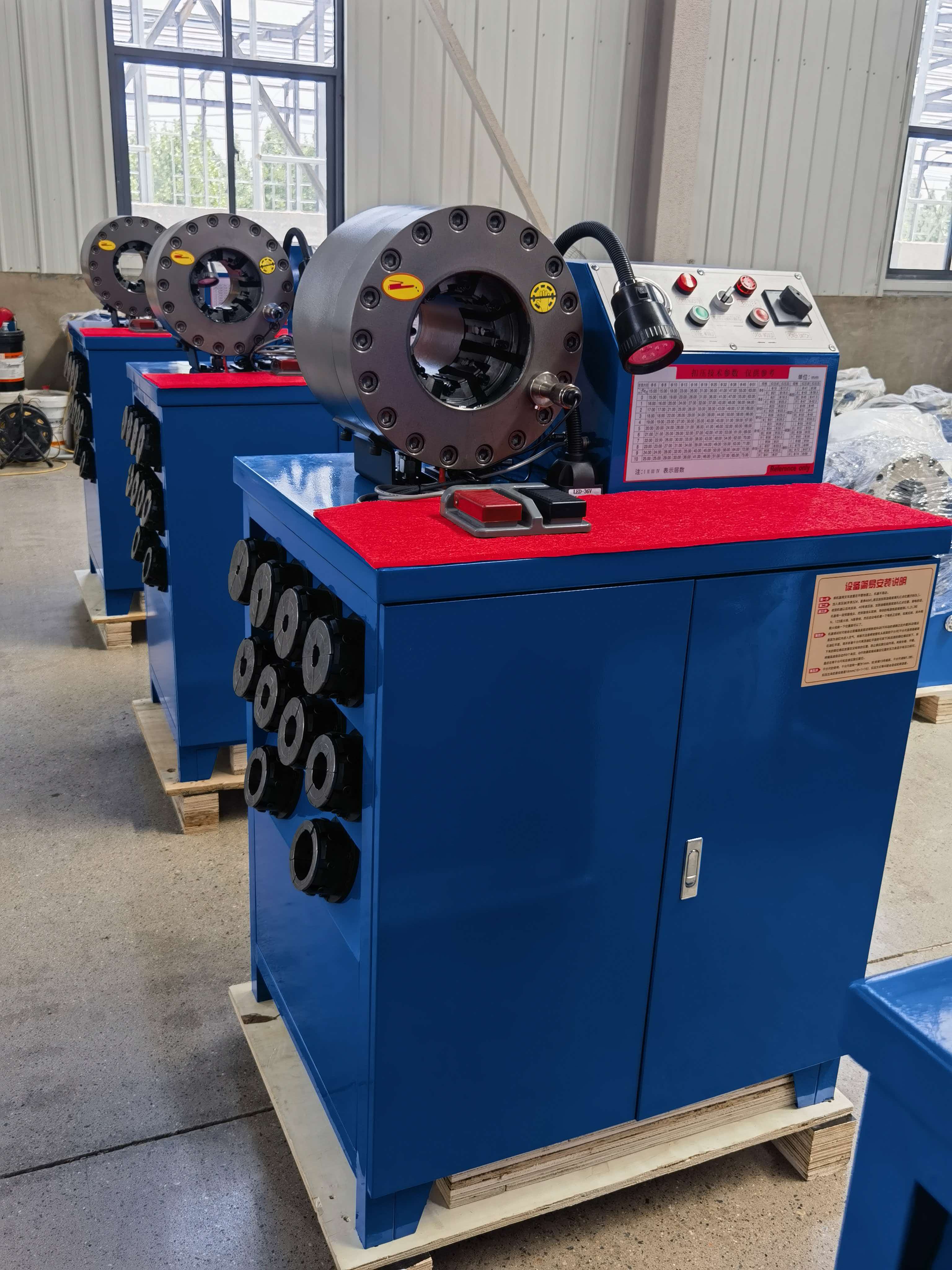
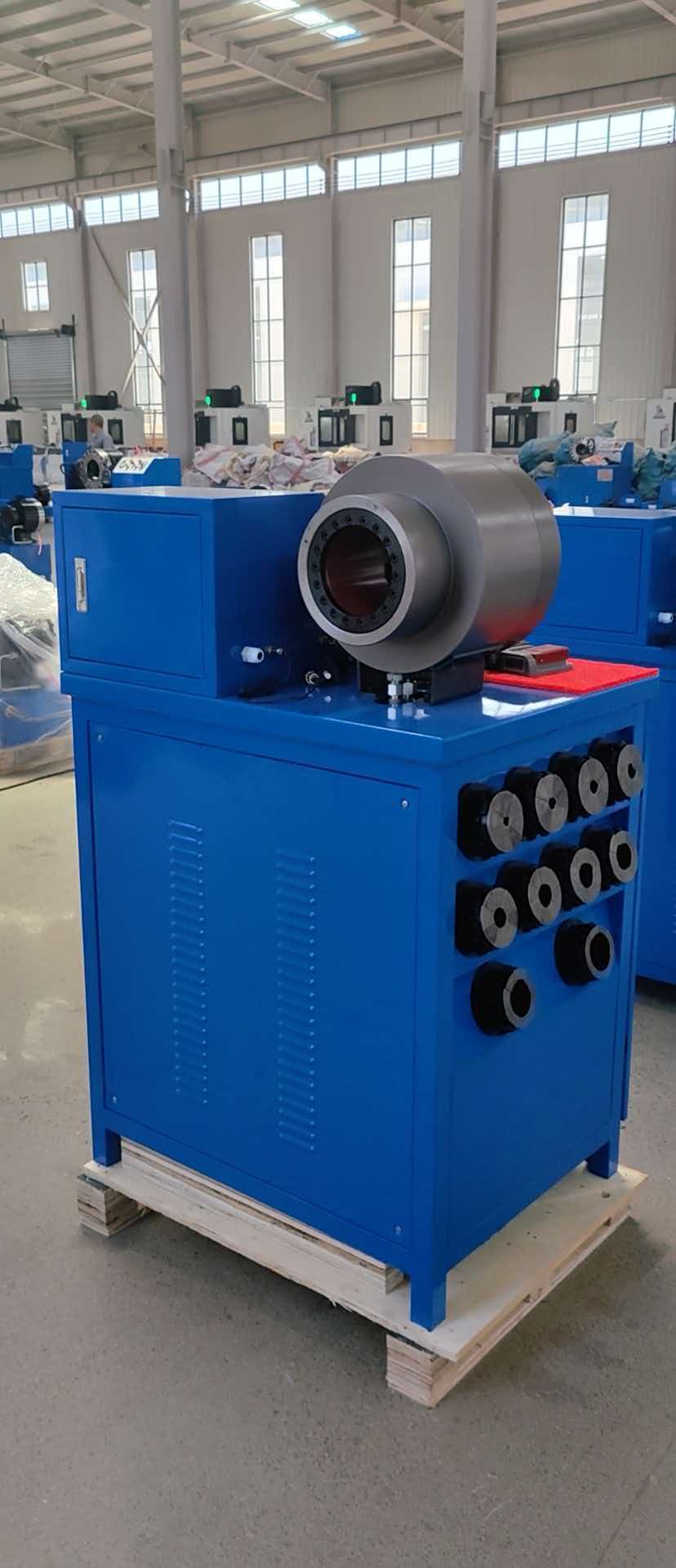
The machine has a foot-pedal cycle, a guarded die head, and a control panel carrying the pressure gauge and the cycle buttons. The cabinet below houses the 4 kW motor and the hydraulic reservoir; 920 × 635 × 1380 mm of floor space and 420 kg gross is a footprint that fits a service bay rather than a production hall.
It fits:
Service benches working on mining, construction and agricultural equipment, where 1-1/4 in to 2 in six-spiral assemblies are routine and the outside hose shop is a two-day delay
Shops that already own a 51 mm machine and turn away the top of the range
Filter press and process-plant maintenance teams that crimp high-pressure power-pack hoses on site and cannot wait for a supplier — the same reason we build hydraulic power units for our own filter presses
Yards that assemble long elbows and need the 135 mm opening to get the fitting into the head
It does not fit:
A shop crimping only 1/2 in 2SN at a few hundred assemblies a month. A 137 t class machine does that work with less floor space and less money.
Anyone crimping reusable couplings. Those are not a crimp system at all, and the die list does not apply.
Anyone who has not settled the hose and fitting brand they will stock. The dies follow the ferrule, so the ferrule decision comes first.
Six checks turn a delivery into a working setup:
Confirm the die set against the hose series and ferrule part number — not against the dash size.
Get the target crimp diameter and tolerance from the current fitting catalogue, and record the revision.
Confirm skive or no-skive for that fitting system; do not extrapolate a skive length from another series.
Cut square, deburr, mark insertion depth, and check the mark has not moved after the cycle.
Measure the first assembly at three points around the ferrule; the average must sit inside the window, and ovality within the maker's limit.
Record machine, die, target, measured values and operator. That record is what a customer audit asks for, and what tells you a die has worn.
| Item | Value |
|---|---|
| Crimping range | 6–76 mm (1/4 in – 3 in) |
| Quantity of dies | 13 sets |
| Maximum open diameter | 135 mm |
| Accuracy | 0.01 mm |
| Crimping force | 800 t (manufacturer's rating) |
| Motor power | 4 kW |
| Machine dimension | 920 × 635 × 1380 mm |
| Package dimension and gross | 980 × 660 × 1530 mm, 420 kg |
Supply voltage, die list and CE documentation are confirmed against your site and hose/fitting stock at quotation.
For a die list matched to your hose and fitting stock, send the part numbers through the hose crimping machine page — we will return the die set, the target diameters, and the cycle settings for each combination.


