
20 years focus on Filter Press!
Excellent quality & 7x24 hours After-sales Service
Tel & WhatsApp+8613932818978
20 years focus on Filter Press!
Excellent quality & 7x24 hours After-sales Service

Technology
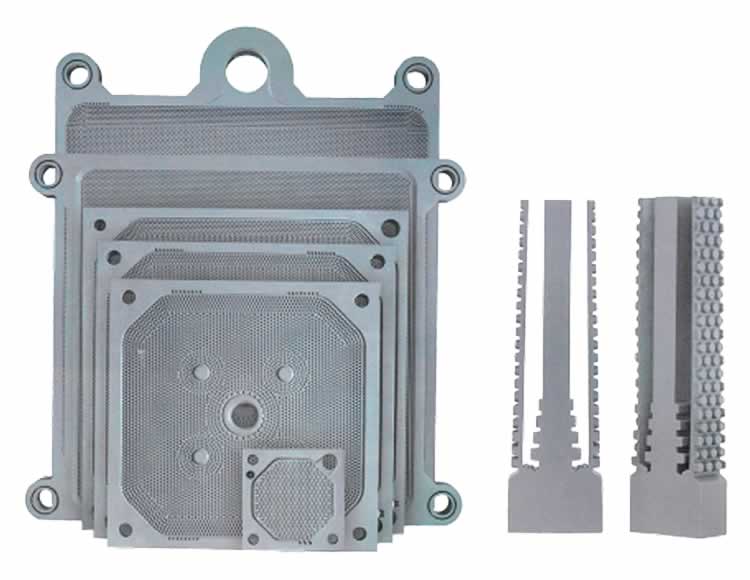
KERTE sizes membrane and chamber filter presses from 250 mm to 2000 mm plates, with chamber volumes calculated against your slurry rather than a standard table. Send us your PSD, solids load, and targ...
Tel & WhatsApp+8613932818978
Product Details
Both numbers come out of the same four-step calculation. What moves the answer is one input most project teams estimate instead of measuring.
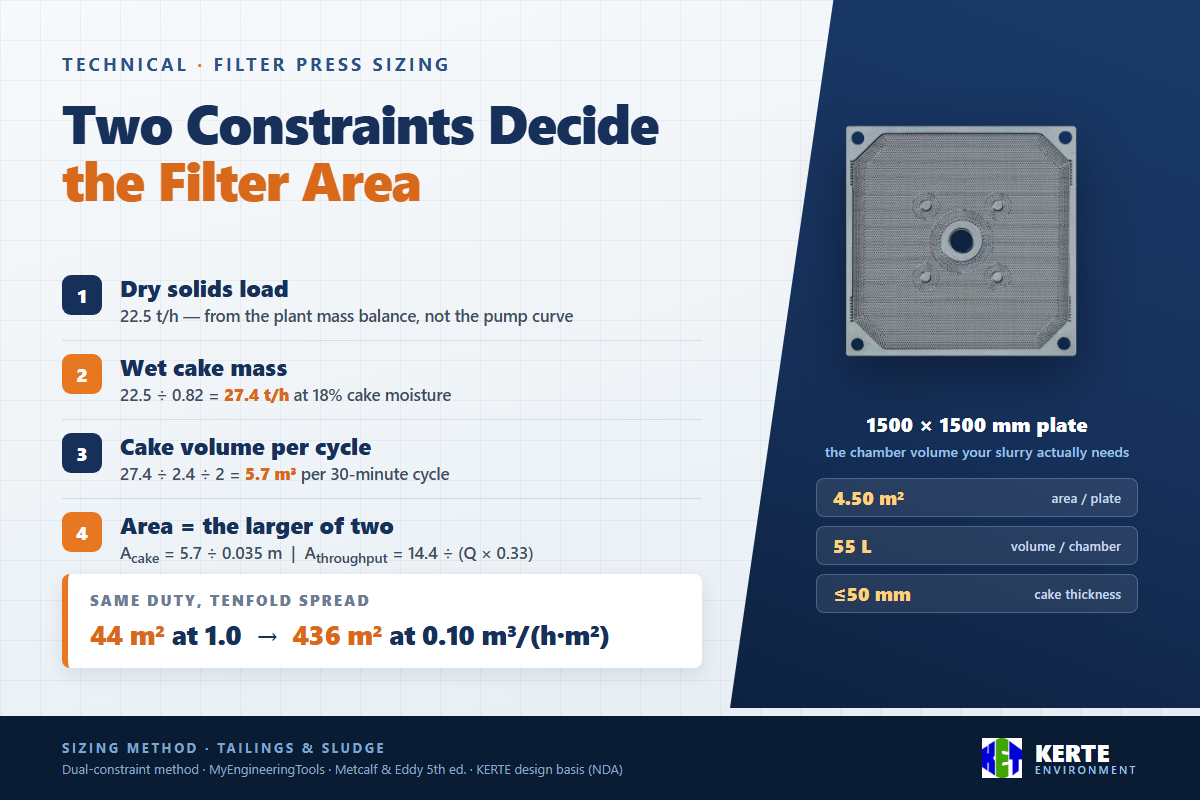
Here is the method, worked through end to end.
Every filter press sizing starts from six numbers. Four come from the process, two come from the site.
| Input | Where it comes from | Typical range |
|---|---|---|
| Dry solids load | Mass balance on the concentrator or treatment plant | t/h or kg/day |
| Feed solids concentration | Slurry sample, by weight | 3–20% sludge, 30–60% mineral slurry |
| Target cake moisture | Discharge or stacking requirement | 12–20% tailings, 20–30% biological sludge |
| Cake density | Lab test on formed cake | 1,100 kg/m³ sludge, ~2,400 kg/m³ iron tailings |
| Cycles per day | Operating schedule, shift pattern | 2–4/day sludge, 24–48/day tailings (24/7) |
| Filtration time per cycle | Cycle time minus fill, squeeze and discharge | 20–30 min tailings |
The rest of the calculation is arithmetic. The accuracy of the result is entirely set by how honest those six numbers are.
Step 1 — dry solids load. If slurry flow and concentration are known, dry solids = slurry mass × solids fraction. If only daily volume is known, convert with slurry density.
Step 2 — wet cake mass. The cake is not dry. Divide dry solids by the cake solids fraction:
Wet cake mass = Dry solids ÷ (1 − cake moisture)
Step 3 — cake volume, then volume per cycle. Divide by cake density, then by the number of cycles:
Cake volume per cycle = (Wet cake mass ÷ cake density) ÷ cycles
A small worked case makes the arithmetic visible. Take 1,200 kg of dry solids per day, a cake at 40% solids, cake density 1,100 kg/m³, and three cycles per day:
Wet cake = 1,200 ÷ 0.40 = 3,000 kg/day
Cake volume = 3,000 ÷ 1,100 = 2.73 m³/day
Per cycle = 2.73 ÷ 3 = 0.91 m³ per cycle
That 0.91 m³ is the chamber volume the press must actually hold. It is the number you match against plate count and chamber depth — not the daily tonnage, which is what most first-pass quotes get built on.
Filter area has to satisfy two independent conditions. Sizing on one and checking the other is how presses end up either blinding early or never filling their chambers.
Constraint A — can the chambers hold the cake? The cake has a mechanical thickness limit. Above roughly 50 mm, cake release becomes unreliable and the press spends more time discharging than filtering.
A_cake = Cake volume per cycle ÷ Maximum cake thickness
Constraint B — can the cloth pass the filtrate in the time available? This is the kinetic constraint, and it needs the filtrate volume, not the cake volume:
A_throughput = Filtrate volume per cycle ÷ (Specific filtration rate × Filtration time)
The final area is the larger of the two:
A_required = max(A_cake, A_throughput)
Specific filtration rate is the input that decides which constraint governs. Published ranges run from 0.1 to 1.0 m³/(h·m²) for the average filtration rate, with sludge-specific values between 10 and 30 L/(m²·min) depending on whether the solids are biological, chemical or inorganic (MyEngineeringTools; Metcalf & Eddy, Wastewater Engineering, 5th ed.).
Now the 22.5 t/h case. The inputs below come from an iron-tailings dewatering specification: 22.5 t/h dry solids, feed at 40% solids by weight, cake moisture 18% per design spec, 1500 × 1500 mm plates, 14 bar feed pressure, continuous 24/7 operation. Particle size runs 0.1 mm to zero — a fine tailings with no coarse fraction to help drainage.
Solids and cake:
Dry solids: 22.5 t/h
Wet cake at 18% moisture: 22.5 ÷ 0.82 = 27.4 t/h
Water leaving with the cake: 27.4 − 22.5 = 4.9 t/h
Water entering with the feed at 40% solids: 22.5 × (0.60 ÷ 0.40) = 33.8 t/h
Filtrate to be pushed through the cloth: 33.8 − 4.9 = 28.9 t/h ≈ 28.9 m³/h
Per cycle, at two cycles per hour (30 minutes each):
Wet cake: 27.4 ÷ 2 = 13.7 t
Cake volume at ~2,400 kg/m³: 13.7 ÷ 2.4 = 5.7 m³ per cycle
Filtrate: 28.9 ÷ 2 = 14.4 m³ per cycle
Constraint A — cake capacity. At a 35 mm cake:
5.7 m³ ÷ 0.035 m = 163 m²
Constraint B — throughput. With 20 minutes of effective filtration time (0.33 h):
| Specific filtration rate | Required area |
|---|---|
| 1.0 m³/(h·m²) — clean granular solids | 44 m² |
| 0.35 m³/(h·m²) — mid-range assumption | 125 m² |
| 0.10 m³/(h·m²) — fine, slow-draining tailings | 436 m² |
A = 14.4 ÷ (Q × 0.33)
Constraint A gives 163 m². Constraint B gives anything from 44 to 436 m² depending on one number.
On 1500 × 1500 mm plates rated at 4.50 m² and 55 litres per chamber, a 5.7 m³ cake load needs roughly 104 chambers, which is about 470 m² of nominal area. That is the same order as the throughput constraint at the slow end — and four times what the cake constraint alone would suggest.
The lesson is not that the formula is unreliable. It is that the cake calculation and the catalogue both assume a filtration rate that fine tailings do not deliver. For a slurry running 0.1 mm to zero, the kinetic constraint governs, and it is set by a measured number.
Cake thickness is a hard ceiling, not a target. Sizing chamber depth to 60 mm to reduce plate count looks efficient on paper and produces cakes that stick, tear at the corners and slow discharge. Most tailings duty sits at 30–40 mm.
Filtrate volume is not feed volume. The water retained in the cake is subtracted before the throughput constraint. Skipping that step overstates the required area by 15–20% on a tailings duty, and understates it on a dilute sludge where retention is proportionally larger.
Cycle time includes everything that is not filtration. Fill, membrane squeeze, core blow, and discharge. A 30-minute cycle on a membrane press often leaves 18–20 minutes of actual filtration. Sizing on the full 30 minutes undersizes the press by a third.
Six data points turn a sizing exercise into a specification:
Dry solids throughput, t/h, with the operating hours behind it
Feed solids concentration by weight, and slurry density
Particle size distribution — D50 and the fines fraction below 20 µm
Target cake moisture, with the reason behind the number
Cake density from a formed-cake test, not a bulk density assumption
Specific filtration rate from a lab filter leaf test or a pilot run
With those six, filter area, chamber volume and cycle time converge. Without them, every quote you receive is a different guess.
KERTE sizes membrane and chamber filter presses from 250 mm to 2000 mm plates, with chamber volumes calculated against your slurry rather than a standard table. Send us your PSD, solids load and target moisture, and we will return the chamber count, filter area and expected cycle time for your duty.
Previous post: Southern Copper's Peruvian branch filed a US$396.5 million goes to a tailings dam
Next post: Hose Crimping Machine
Related content


