
20 years focus on Filter Press!
Excellent quality & 7x24 hours After-sales Service
Tel & WhatsApp+8613932818978
20 years focus on Filter Press!
Excellent quality & 7x24 hours After-sales Service

Industry News
That single line item is the most honest number in Latin American tailings management right now. Not because the company chose badly, but because it shows what a conventional tailings decision still c...
Tel & WhatsApp+8613932818978
Product Details
That single line item is the most honest number in Latin American tailings management right now. Not because the company chose badly, but because it shows what a conventional tailings decision still costs when a mine is already built around a dam.
Southern Peru submitted its fifth Technical Supporting Report (ITS, Informe Técnico Sustentatorio) to Senace, Peru's environmental certification agency. Peruvian business daily Gestión and mining outlets Minería y Proyectos and ProActivo reported the filing from 13 October 2026. Filing is not approval — Senace must evaluate the package before any works begin, and no construction schedule has been published.
| Component | Amount (US$) | Share |
|---|---|---|
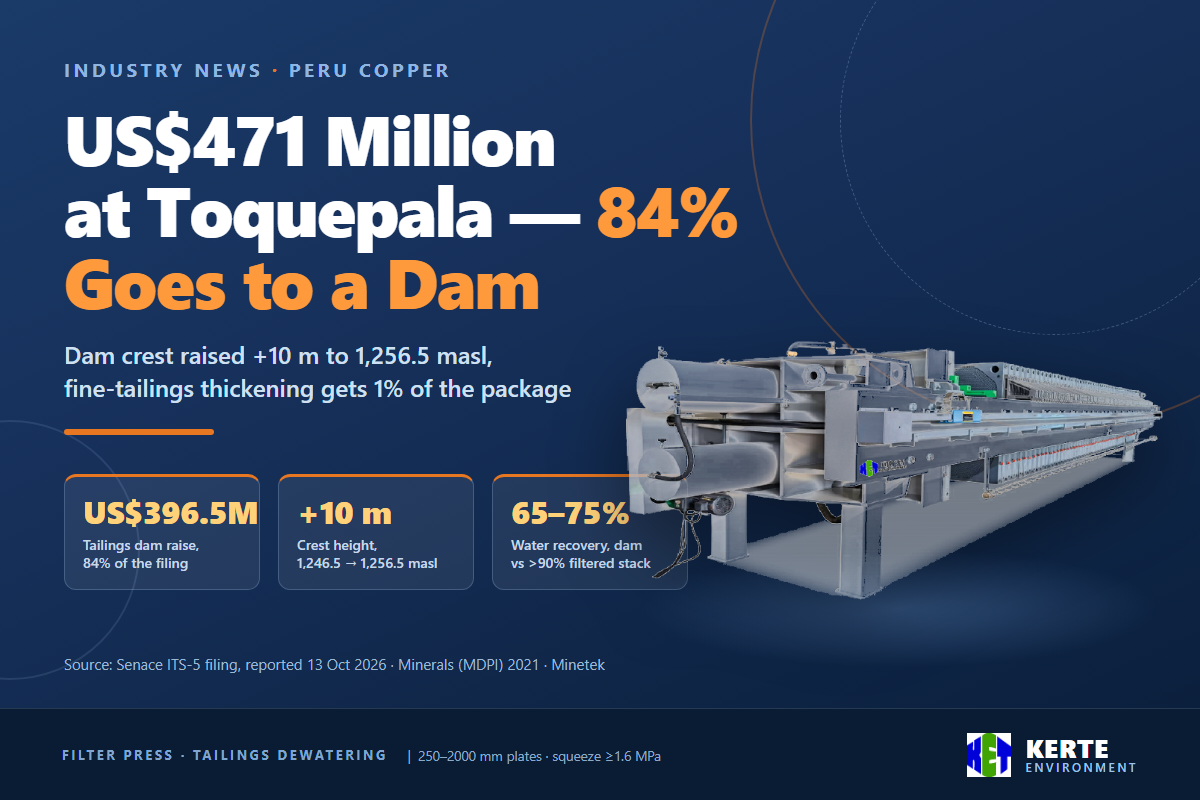
| Quebrada Honda dam raise, +10 m crest (1,246.5 → 1,256.5 masl) | 396.5 million | 84% |
| East waste-rock dump expansion, 484.8 → 500.9 ha | 52.49 million | 11% |
| Covered backup-equipment store | 5.61 million | 1.2% |
| Villa Staff camp wastewater plant | 5.37 million | 1.1% |
| Dredging, recovered-water pumping, fine-tailings thickening | 4.56 million | 1.0% |
| Drill-core store, workshop upgrade, plant amenities | 6.51 million | 1.4% |
| Total | 471.09 million | 100% |
Two numbers in that table matter more than the headline.
The first is US$4.56 million for dredging, recovered-water pumping and a fine-tailings thickening system. That is 1% of the package, and it buys water recovery. The mine is not ignoring water — it is buying the cheapest increment of it.
The second is the production context. Toquepala produced about 113,700 tonnes of copper in the first half of 2026, 11.5% less than a year earlier. A mine with falling output is spending nearly four hundred million dollars on storage capacity, not on throughput.
The previous ITS at the same operation, approved on 6 June 2025, included three thickeners to recover water from tailings for roughly US$78.5 million. Thickeners first, dam raise second. That sequence tells you how the option was framed internally.
A dam raise at an operating mine is an incremental project. The footprint exists, the pipeline exists, the permits have a template, the workforce is on site. The engineering is mature and the schedule is predictable.
Filtration is a different project type. It replaces a slurry circuit with a dewatering plant, a conveyor or truck fleet, and a stack that has to be compacted and reclaimed. It is not an upgrade to the tailings line — it is a new plant bolted onto the back of the concentrator.
The published cost comparison is more favourable to filtration than most operators assume, once the whole picture is counted. A peer-reviewed review of tailings dam failures and disposal alternatives (Minerals, MDPI, 2021) reported that filtered tailings with compaction showed initial capital expenditure savings of 38% and average capital savings of 64% against slurry deposition behind a dam, with an average total cost saving of 33% over the facility life. The same review found filtered tailings cut storage volume by about 80% and recovered roughly twice as much water by mass.
Those savings only appear when the dam's own future raises are priced in. A mine that books the first raise as a standalone project will always find filtration more expensive, because the comparison stops at the dewatering plant's capital line.
Water recovery is the part of the case that survives scrutiny without any assumption about future dam raises.
Well-operated conventional tailings dams with pond control and seepage collection recover 65–75% of process water. Filtered dry stacking pushes recovery above 90%, because the water leaves the circuit at the filter press instead of draining into an impoundment over years (Minetek, retrieved 2026-11-02).
For a Peruvian operation on the dry western slope, that gap is not a sustainability metric. It is make-up water that does not have to be purchased, pumped, desalinated or permitted.
There is a boundary condition worth stating plainly. In the Atacama region, the cost of tailings filtration is comparable to the cost of seawater desalination — which is why dry stacking took hold first in northern Chile and southern Peru, where freshwater is the binding constraint, not where regulation is strictest (Minerals, MDPI, 2021).
Filtration has a throughput ceiling that is rising but has not disappeared. The same 2021 review put the economic limit at tailings production rates below roughly 20,000 dry tonnes per day, while noting that the limit is moving upward as filter press capacity and plate sizes grow.
Three technical limits sit behind that number:
Fines and clay content. Ultrafine tailings blind cloth quickly and compress into a low-permeability cake. Cycle time climbs and the required area climbs with it.
Energy and consumables. Filter presses run high-pressure cycles — typically 1,600–2,100 kPa with cycle times up to about 20 minutes — and cloth is a recurring cost, not a one-time purchase.
Cake handling downstream. A filter cake has to be conveyed, stacked, compacted and reclaimed. That equipment is part of the capital case and is easy to leave out of a first-pass comparison.
For any operation facing the same decision Toquepala just made — raise, or filter — the useful test is narrower than a technology debate:
How many raises are left? One raise at a time always prices in favour of the dam. The full remaining storage plan is the honest comparison.
What does water cost at the fence? Pumped, purchased, desalinated or permitted — the number sets how much of the dewatering plant pays for itself before any tailings benefit is counted.
What is the tailings PSD? Fines fraction and clay content decide cycle time, cloth life and required filter area. This is a lab test, not an estimate.
Can the site handle cake, not slurry? Conveyor or truck, stack slope, compaction, dust and progressive reclamation all belong in the capital number.
Vale is the reference case for where this goes. The company reported that more than 80% of its iron ore production in Brazil did not depend on dams for tailings storage in 2025. That did not happen through one project. It happened through a decade of adding dewatering capacity to a fleet of operations.
Toquepala's filing is not a signal that filtration lost. It is a signal that the Peruvian copper belt is entering a phase where storage capacity is being bought at a high price per metre of crest, one mine at a time.
Every one of those decisions reopens the same calculation, and the calculation gets better for filtration each time a raise is priced.
KERTE builds high-pressure membrane filter presses for copper, iron and polymetallic tailings, with plate sizes from 250 mm to 2000 mm and squeeze pressures up to 1.6 MPa and above. If your operation is sizing a dewatering line against a dam raise, send us your tailings PSD, solids throughput and target cake moisture — we will return a chamber volume and filter area sized to your slurry, not to a catalogue.


